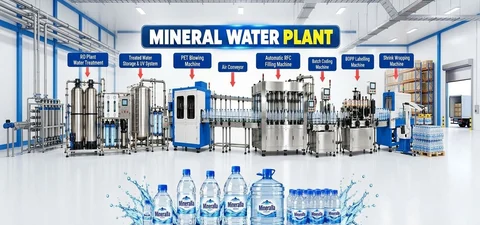
In India, packaged drinking water is classified as a food product and is strictly regulated under the Bureau of Indian Standards (BIS) Act. Selling bottled water without a valid ISI mark (governed by standard IS 14543) is a federal offense. For anyone planning a water plant project, understanding the mandatory compliance steps and budgeting for the isi mark registration fees is a critical pre-requisite for a successful launch.
Why the ISI Mark is Mandatory
The ISI mark represents a certification of purity and safety. It assures consumers that the water has undergone rigorous multi-barrier filtration, is free from toxic chemicals or biological contaminants, and has been packaged in a sterile environment. To maintain this license, a plant must operate an in-house testing laboratory with a qualified microbiologist and chemist to test hourly samples.
Breakdown of ISI Mark Registration Fees & Expenses
The total cost to acquire and maintain a BIS license goes beyond a single application fee. Here is a comprehensive breakdown of the typical financial commitments required:
- Application Audit Fees: The initial filing fee paid to the Bureau of Indian Standards, which typically ranges from ₹1,000 to ₹5,000.
- Preliminary Plant Inspection Fee: The travel charges for the BIS officer visiting your plant site, usually around ₹3,000 to ₹5,000 per visit.
- Sample Testing Charges: Independent testing of your water samples in a government-approved laboratory. This is a significant cost, ranging from ₹15,000 to ₹30,000 depending on the complexity of the parameters tested.
- Annual Marking Fee: The fee paid to BIS based on your annual production volume. For a standard startup plant, the minimum annual marking fee starts at approximately ₹75,000 to ₹1,00,000, payable in advance.
- In-House Lab Equipment: To pass the BIS audit, you must install an in-house laboratory. This equipment (incubators, autoclaves, laminar flow hoods, chemical testing kits) requires an investment of ₹3 Lakhs to ₹5 Lakhs.
The Step-by-Step BIS Certification Process
The certification pathway requires meticulous planning and execution:
- Infrastructure Preparation: Design your plant layout to separate raw water treatment, bottle blowing, filling, and packaging, ensuring zero cross-contamination.
- Machinery Installation: Install food-grade machinery constructed of SS 316L, complete with a Clean Room (Class 10,000 or better) for filling.
- Application Submission: File the BIS application along with proof of land ownership, machinery lists, lab equipment lists, and qualifications of your lab staff.
- BIS Audit: A BIS officer inspects the plant, evaluates the hygiene protocols, checks the calibration of lab equipment, and seals water samples in your presence.
- Lab Testing & Grant of License: The samples are sent to an independent national lab. Upon receiving a passing report, BIS issues your CM/L (Certification/Licence) number, allowing you to print the ISI mark.
Consulting with an experienced turnkey provider makes this process smooth and error-free. At Krupashindu, our consulting engineers guide you through every step of the ISI/BIS Licensing and Compliance Services, ensuring your plant layout is approved on the first attempt.