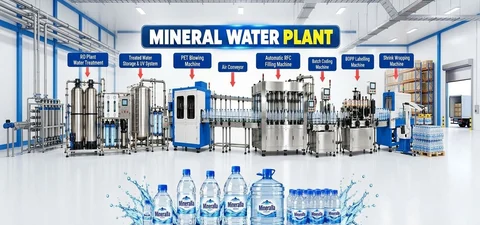
Launching a commercial water business requires a blend of capital investment, technical engineering, and regulatory approval. Whether you are seeking bank financing or drafting a business plan, preparing a comprehensive mineral water plant project report is your first step. Additionally, selecting the correct mineral water packing machine and designing the purification framework are crucial factors that determine the operational efficiency of your drinking water project.
Why You Need a Mineral Water Plant Project Report
A project report is a formal document that serves as a blueprint for your business. It is required by financial institutions for securing business loans and by government departments for obtaining industrial subsidies. A professional project report must cover:
- Market Analysis: Target demographics, local competitor analysis, and demand forecasting.
- Technical Specifications: Detailed raw water analysis, selected treatment scheme (RO, UV, Ozone), and machinery capacities (BPH/BPM).
- Financial Projections: Capital expenditure (CAPEX) for land, civil structures, and machinery, along with operational expenditure (OPEX) including power, raw materials (preforms, caps), labor, and projected return on investment (ROI).
- Civil Layout: Architect-approved plant drawing demonstrating compliance with hygiene zoning requirements.
Selecting the Right Mineral Water Packing Machine
Your packing machine is the workhorse of your facility, directly influencing your plant's throughput and labor requirements. Depending on your target market, you should evaluate the following packing configurations:
- RFC Monoblock Filling Machines: The industry standard for PET bottles. These machines combine rinsing, filling, and capping into a single enclosed chamber, preventing dust or biological contamination. They are rated in Bottles Per Minute (BPM) or Bottles Per Hour (BPH).
- Bulk Jar Fillers: Designed for 20-liter jars. These machines automate the decapping, washing (using hot water, chlorine, and fresh water), filling, and sealing of large containers.
- Pouch Packaging Machines: Ideal for low-cost, high-volume rural markets. Pouch packers use roll-stock film to form, fill, and seal water pouches automatically.
- Mineral Water Packing Machine (Shrink Wrapper): End-of-line machines that bundle a set of bottles (e.g., 2x3 or 3x4 configurations) in plastic film and pass them through a heating tunnel, preparing them for transport without requiring expensive cardboard cartons.
Key Stages of a Successful Drinking Water Project
Executing your project successfully requires a structured timeline:
- Raw Water Testing: Never skip this step. The chemical and physical composition of your source water decides the design of your filtration membranes.
- Site Engineering: Setting up clean-room conditions (Class 10,000 positive pressure air lock chambers) for the filling zone to comply with BIS guidelines.
- Machinery Integration: Selecting a unified turnkey partner who can install and synchronize the water treatment unit, blowing unit, filling block, and packaging systems.
At Krupashindu, we don't just supply high-quality equipment; we partner with you from day one. We help you draft custom project reports, select the optimal Mineral Water Packing and Wrapping Machinery, and execute your drinking water project flawlessly. Contact us today to consult with our lead engineers.