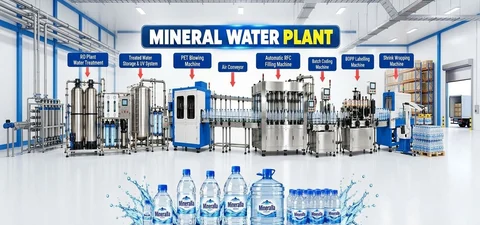
Starting a small scale mineral water plant is an excellent business model for regional markets, offering low starting capital and rapid return on investment. However, building a successful facility requires more than putting machines in a room. To pass Bureau of Indian Standards (BIS) inspection and secure an ISI mark, you must follow strict project layout guidelines and choose the right packaging essentials. Let's explore how to design a high-efficiency layout on a compact footprint.
BIS-Compliant Layout Requirements
BIS has defined precise spatial zoning to prevent contamination of packaged drinking water. A typical small-scale plant requires a minimum area of 1,00,0 to 1,500 square feet, structured into distinct chambers:
- Raw Water Storage & Filtration Zone: Housing the source water storage tank, sand filters, carbon filters, water softeners, and the RO treatment skid.
- Filling & Capping Zone (Clean Room): This is the most critical area. It must be isolated with partition walls, equipped with positive-pressure air lock chambers (HEPA filters), and accessible only through a dedicated changing room.
- Bottle Blowing Area: Keeping the blowing machine separate prevents heat and noise from affecting the clean room and quality laboratories.
- In-house Quality Control Laboratory: Divided into chemical and microbiological testing zones. The lab must have direct visual access to the filling line.
- Finished Goods Warehouse: Clean, dry space to stack bundled cartons or shrink-wrapped packs before shipment.
Optimizing Space and Workflow
When designing a compact layout, implement a U-shaped or straight-line layout to ensure a continuous material flow:
- Raw water enters the filtration skid on one side.
- Preforms are blown into bottles, which travel on a conveyor directly into the filling room.
- Filled and capped bottles exit the clean room onto an outfeed conveyor, where labeling and batch coding take place.
- Finally, bottles are wrapped, palletized, and stored in the warehouse near the dispatch bay.
Choosing Your Packaging Materials
For a small-scale plant, packaging choices directly determine your market reach and profit margins:
- PET Bottles (200ml to 2 Liters): The standard retail configuration. Ensure you select preforms made from food-grade virgin resin with high blowing consistency to prevent thin spots or leaks.
- 20-Liter Bulk Jars: Highly popular for homes and offices. Jars are returnable and reusable (up to 30-40 cycles), meaning your packaging cost per liter is extremely low, making this a high-margin product.
- Shrink Wrapping vs. Cardboard: Instead of expensive cardboard boxes, use a Semi-Automatic Shrink Wrapper to bundle bottles in high-strength LDPE film, cutting secondary packaging costs by up to 60%.
At Krupashindu, we specialize in engineering layouts for small scale mineral water plants that maximize output within limited spaces while achieving full compliance with BIS guidelines. We supply layout drawings, architectural consultation, and integrated Water Processing Equipment. Contact our layout experts today to begin planning your plant design.