Blog Hub
Guides

Water Bottle Manufacturing Cost & Machinery Guide

Author
Global Projects Director
Date
July 30, 2026
Reading Time
9 min read
Water Bottle Manufacturing Cost & Machinery Guide

Starting a water bottling venture requires a clear understanding of capital expenditures and operational costs. Evaluating the **water bottle manufacturing cost** alongside the configuration of your **water bottle plant machinery** is the key to designing a profitable business model. Let's analyze the essential machines and the breakdown of total setup costs.

1. The Core Water Bottle Plant Machine Configuration

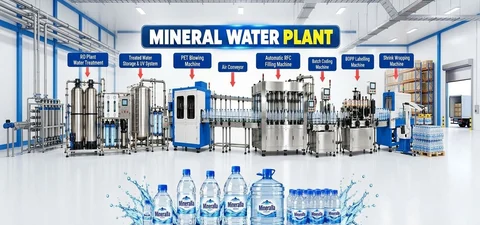
A modern production facility requires synchronized equipment to transform raw materials into packaged products. The main **water bottle plant machine** stages include:

  • PET Blow Molding Machine: Heats and inflates PET preforms into finished bottles. Having a high-speed automatic blowing unit reduces raw bottle procurement costs by up to 40%.
  • Rinsing, Filling, & Capping (RFC) Monoblock: Rinses the inside of blown bottles with purified water, fills them with precise volumes, and seals them with plastic caps under sterile conditions.
  • Labeling Machine: Applies OPP, BOPP, or sticker labels automatically around the bottle body.
  • Shrink Wrapping Machine: Bundles finished bottles in plastic film (packs of 6, 12, or 24) and heats it to create stable packaging for logistics.

2. Breakdown of Water Bottle Manufacturing Cost

The total cost to manufacture a single bottle of water depends on raw materials, utilities, labor, and depreciation:

  • PET Preform: Typically the largest recurring expense (approx. 50-60% of unit cost).
  • Plastic Cap: A minor but recurring cost (approx. 10-15% of unit cost).
  • OPP Label: Cost depends on paper or film quality and graphics (approx. 5-10% of unit cost).
  • Shrink Film and Electricity: Operational expenses involved in running the packaging and heating tunnels.
In-house manufacturing using specialized **water bottle plant machinery** reduces the per-unit cost significantly compared to outsourcing pre-blown bottles.

3. Selecting Between Semi-Automatic and Fully Automatic Lines

For startup ventures, a semi-automatic line lowers the initial capital requirement, but increases labor costs. For scaling operations, fully automatic lines (such as a 60 or 90 BPM system) minimize human contact, ensure absolute hygiene (essential for BIS/ISI standards), and deliver a rapid return on investment due to higher hourly throughput.

4. Engineering a Profitable Factory Layout

Proper layout planning prevents cross-contamination and optimizes production flow. The blow molding zone must be separated from the clean-room filling area. Choosing a unified turnkey partner ensures that your water treatment plant, filling line, and packaging machinery are engineered to work together with no bottlenecks.

Krupashindu offers customized feasibility studies and supplies state-of-the-art **water bottle plant machinery** tailored to your budget. Contact our team to receive a detailed project cost analysis report.

Share Article
Back to Hub

Need expert advice?

Our engineering team is ready to help you architect your next beverage production plant.

Chat with Krupashindu Expert on WhatsApp for Mineral Water Plant SetupChat with us