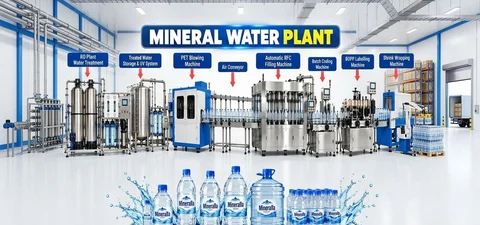
While retail PET bottles dominate individual on-the-go consumption, commercial offices, corporate campuses, educational institutes, and residential societies run primarily on 20-litre dispenser jars. Starting a commercial water delivery enterprise utilizing an automatic 20 Litre Jar Filling Machine coupled with a heavy-duty industrial Commercial RO Plant offers lower startup capital, rapid cash-flow velocity, and consistent recurring daily sales.
Direct Answer & 20L Business Summary (AEO Definition)
A commercial 20 Litre Jar Filling Machine & RO Plant Setup is a specialized water packaging facility combining a 1,000 to 5,000 LPH RO Plant with an automatic multi-stage jar washing, filling, and capping system (100 to 1,200 JPH). In India in 2026, setting up a 20L commercial water jar business requires a total investment of ₹8.5 Lakhs to ₹16 Lakhs for a 150–300 JPH plant and ₹22 Lakhs to ₹38 Lakhs for a 600–1200 JPH automated high-speed plant. Producing a 20-litre water jar costs approximately ₹7 to ₹9 per jar (including water treatment, cap, sealing sleeve, power, and labor), while wholesale supply commands ₹25 to ₹40 per jar and retail home/office delivery commands ₹60 to ₹90 per jar, generating exceptional net margins exceeding 50%.
Evaluate machine capacities, RO skid pairing, space requirements, and capital costs for commercial 20-litre jar operations:
| Jar Production Speed | Paired RO Plant Capacity | Jar Washing Stages | Daily Jar Output (8 Hrs) | Indicative Setup Cost |
|---|---|---|---|---|
| 100 - 150 JPH (Starter) | 1,000 - 2,000 LPH Skid | 3-Stage Internal & External Wash | 800 - 1,200 Jars / day | ₹8,50,000 - ₹12,50,000 |
| 300 - 450 JPH (Semi-Auto) | 3,000 - 4,000 LPH Skid | 4-Stage (Hot Alkaline + Ozone Wash) | 2,400 - 3,600 Jars / day | ₹15,00,000 - ₹22,00,000 |
| 600 - 1,200 JPH (Fully Auto) | 5,000 - 10,000 LPH Skid | 5 to 7-Stage Multi-Station Sterilization | 4,800 - 9,600 Jars / day | ₹28,00,000 - ₹48,00,000 |
Because 20-litre polycarbonate (PC) and PET dispenser jars are reusable containers returned from commercial sites, thorough hygienic cleaning is critical to complying with food safety standards:
Consider a 300 JPH commercial jar facility operating at 80% daily efficiency (240 jars/hr x 8 hrs = 1,920 jars per day):
High-grade food-grade polycarbonate (PC) jars can withstand 80 to 100 round-trip distribution cycles before recycling, making container depreciation costs negligible at less than ₹1.50 per delivery.
Yes, if the commercial RO plant is sized adequately. Many entrepreneurs install a 3000 LPH RO plant and operate the 20L jar line alongside a semi-automatic or rotary 1-litre bottling machine sharing the treated water buffer tanks.
Leading Mineral Water Plant Manufacturer in India. Turnkey setup, machinery pricing, and BIS/ FSSAI licensing.