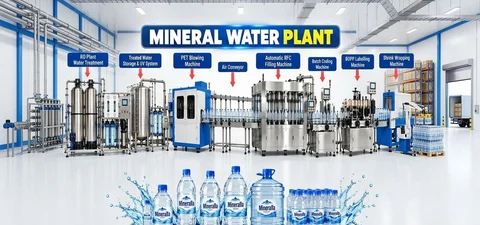
Starting a packaged drinking water manufacturing business is one of the most lucrative and future-proof industrial opportunities in India today. With the Indian bottled water industry expanding at an unprecedented compound annual growth rate (CAGR) exceeding 18.5%, increasing urbanization, health awareness, and travel demand have transformed clean drinking water into an everyday consumer essential.
Whether you are planning to launch your own proprietary water brand (in 200ml, 500ml, 1-Litre, and 2-Litre PET bottles) or supply high-demand 20-Litre bulk dispenser jars to corporate and residential hubs, this complete guide provides the authoritative technical blueprint on how to start a mineral water plant in India in 2026. From raw water hydrogeology and the full manufacturing process to legal BIS licensing and realistic business profit margins, here is everything you need to build a profitable enterprise.
India consumes billions of litres of bottled water every year. The commercial market is split into two massive segments:
Entrepreneurs who invest in a modern, automated turnkey mineral water plant setup benefit from rapid payback periods, tax incentives under government MSME schemes, and continuous year-round demand.
Under the statutory guidelines established by the Bureau of Indian Standards BSI (ISI), a packaged drinking water plant cannot be set up in an arbitrary open space. The factory premises must be scientifically zoned to maintain complete microbiological hygiene:
The facility must feature isolated physical partitions:
Need architectural assistance? Our engineering technocrats provide custom 2D/3D plant layouts conforming to BIS specifications through our turnkey engineering and plant consulting services.
In India, commercial bottled water falls under two distinct categories: Packaged Drinking Water (governed by BIS ISI), which purifies raw groundwater, borewell water, or municipal supply using reverse osmosis, controlled remineralization, and ozonation (representing over 95% of commercial operations), and Natural Mineral Water (governed by BIS IS:13428), which must be sourced directly from certified underground or natural spring sources without altering its natural mineral composition. For commercial packaged drinking water conforming to IS:14543, the complete multi-barrier purification and bottling process involves:
Raw water is pumped into raw water storage reservoirs where preliminary chlorine dosing (sodium hypochlorite) oxidizes dissolved iron and destroys surface bacterial colonies.
Water passes through a vertical pressure sand filter containing graded silica sand, pebbles, and gravel to filter out suspended solids, turbidity, silt, and coarse particulate matter down to 30 microns.
The water flows through high-iodine virgin coconut shell activated carbon to adsorb residual chlorine, eliminate unpleasant odors, remove pesticides, and clarify water color.
Before entering high-pressure membranes, food-grade antiscalant is precisely dosed to prevent membrane scaling. The water is then filtered through 10-micron, 5-micron, and 1-micron wound polypropylene cartridge filters to trap fine suspended impurities.
A heavy-duty high-pressure vertical multistage pump forces pre-treated water through semi-permeable thin-film composite (TFC) RO membranes at 150–220 PSI. This process removes 95–99% of excess Total Dissolved Solids (TDS), heavy metals (lead, arsenic, mercury), nitrates, and chemical contaminants. Explore our heavy-duty industrial RO plants engineered for high permeate recovery and energy efficiency.
Pure RO water typically has a very low TDS and slightly acidic pH. A controlled mineral dosing skid introduces essential salts such as Magnesium Sulphate and Potassium Bicarbonate to meet IS 14543 mineral requirements (min. 75 mg/L TDS) and deliver the crisp, refreshing taste consumers love.
Before filling, water undergoes dual-barrier disinfection. First, high-intensity Ultraviolet (UV) radiation destroys any remaining bacterial DNA without adding chemicals. Next, an industrial corona-discharge ozone generator infuses medical-grade ozone (O3) into the water. Ozone provides vital residual sterilization inside the sealed bottle, ensuring water remains pure for over 6 to 12 months.
Empty PET preforms are heated and blow-molded into crystal-clear bottles. The bottles are immediately transported on air conveyors into an automated monoblock RFC machine where they are inverted, washed with ozonated water, filled to exact liquid volume, and sealed with tamper-evident caps. Learn more about our automatic monoblock rinsing-filling-capping bottling machines.
Bottles pass an optical inspection lamp, followed by an automatic shrink sleeve or sticker labeling machine, an industrial continuous inkjet (CIJ) coder (printing MRP, batch number, and manufacturing date), and are finally grouped into 12 or 24-bottle packs using an automatic shrink-wrapping machine.
Because packaged drinking water directly impacts public health, regulatory compliance in India is stringent. You must secure the following licenses prior to commercial dispatches:
A common question is: How much capital is required to start a mineral water plant in India? Total investment depends on your target bottle-per-hour (BPH) capacity and automation level:
| Plant Capacity | Machinery Cost (Excl. Taxes) | Civil & Lab Setup | Total Estimated CAPEX |
|---|---|---|---|
| 1000 BPH (Semi-Automatic) | ₹14 Lakhs – ₹18 Lakhs | ₹8 Lakhs – ₹12 Lakhs | ₹25 Lakhs – ₹32 Lakhs |
| 2000 BPH (Fully Automatic Monoblock) | ₹24 Lakhs – ₹34 Lakhs | ₹12 Lakhs – ₹16 Lakhs | ₹40 Lakhs – ₹52 Lakhs |
| 4000 to 6000 BPH (High-Speed Rotary) | ₹50 Lakhs – ₹75 Lakhs | ₹20 Lakhs – ₹30 Lakhs | ₹75 Lakhs – ₹1.10 Crore |
For a line-by-line financial breakdown, read our detailed Mineral Water Plant Setup Cost, Process & Profit Analysis.
Is the mineral water business profitable in India? Yes, exceptionally profitable when production waste is minimized and distribution networks are secured.
Total Manufacturing Cost per 1L Bottle: Approximately ₹4.20 to ₹5.20.
Operating a 2000 BPH plant at just 60% capacity (approx. 10,000 bottles per day across a single 8-hour shift) generates a net daily operating profit of ₹30,000 to ₹40,000, translating to a monthly net profit of ₹7.5 Lakhs to ₹10 Lakhs.
The success of your bottling plant hinges on machinery reliability. Low-cost machinery made with substandard stainless steel (SS 202 instead of food-grade SS 304/316) causes recurring breakdown, water contamination, and failed BIS quality audits. When evaluating manufacturers, verify:
At Krupashindu Consulting Engineers, we bring over 20+ years of technical mastery, an ISO 9001:2015 certified production hub in MIDC Rabale Navi Mumbai, and 500+ successful plant installations worldwide (including 180+ turnkey setups across Maharashtra and Western India). From bankable Detailed Project Reports (DPR) to machinery manufacturing and lifetime AMC, we are your end-to-end partner. Contact our engineering team today to request a customized quotation and project feasibility plan.
Leading Mineral Water Plant Manufacturer in India. Turnkey setup, machinery pricing, and BIS/ FSSAI licensing.