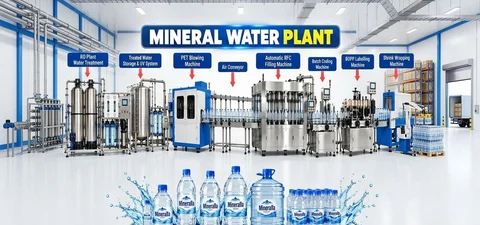
Operating a legally compliant commercial bottled water enterprise in India requires obtaining mandatory certification from the Bureau of Indian Standards (BIS). However, many new entrepreneurs confuse the two fundamental standards: IS 14543 for Packaged Drinking Water (Other than Packaged Natural Mineral Water) and IS 13428 for Packaged Natural Mineral Water. Understanding their engineering, legal, and operational differences is crucial before investing capital.
| Parameter | IS 14543 (Packaged Drinking Water) | IS 13428 (Natural Mineral Water) |
|---|---|---|
| Source Water | Any potable water source (borewell, river, municipal tap) | Designated natural subterranean spring or artesian well only |
| Permitted Purification | Reverse Osmosis (RO), demineralization, remineralization allowed | Physical filtration (micron/sand) only; NO RO, NO chemical alteration |
| Total Dissolved Solids (TDS) | 75 to 500 mg/L | 150 to 700+ mg/L naturally occurring |
| Mandatory Minerals | Calcium (min 20 mg/L), Magnesium (min 10 mg/L) | Must contain naturally balanced minerals; no external dosing |
| Packaging Medium | PET bottles, 20L PC jars, pouches (where state permits) | Premium glass bottles, BPA-free PET, sealed at natural source |
| Target Market | Mass retail (₹10–20/bottle), offices, households, catering | Luxury hotels, fine dining, upscale supermarkets (₹60–150/bottle) |
Both standards legally mandate setting up an in-house chemical and microbiological testing laboratory operated by qualified chemists and microbiologists approved by the BIS audit team:
No. Under the Food Safety and Standards Act (FSSAI) and Bureau of Indian Standards Act, selling packaged drinking water without a valid BIS ISI certification is a non-bailable offense leading to factory closure, seizure of goods, and severe financial penalties.
IS 14543 applies to Packaged Drinking Water where water from borewells or municipal lines is purified using Reverse Osmosis (RO) and remineralized. IS 13428 applies to Natural Mineral Water which must originate from a protected underground spring, bottled at source without changing its natural mineral composition.
The standard timeline is typically 45 to 90 days from the date of online application submission, depending on complete laboratory readiness and government lab test reports.
Krupashindu provides complete in-house laboratory setup and 100% first-audit BIS clearance support: Explore Our Turnkey Services or Consult Our Quality Technocrats.
Leading Mineral Water Plant Manufacturer in India. Turnkey setup, machinery pricing, and BIS/ FSSAI licensing.