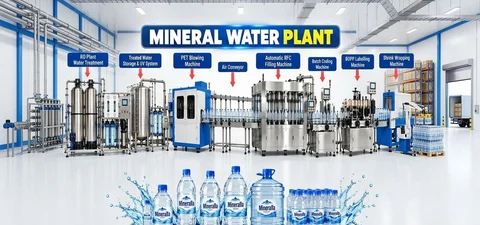
The global and domestic commercial beverage landscape is experiencing historic expansion. Driven by heightened public health awareness, rising urban purchasing power, rapid hospitality growth, and the explosive rise of quick-commerce grocery delivery platforms, the demand for hygienic, safe, and premium packaged drinking water has never been greater. For entrepreneurs, commercial investors, and industrial beverage enterprises planning to invest in 2026, understanding the end-to-end engineering architecture of a modern Mineral Water Plant is the foundational milestone required to ensure long-term operational profitability, food-grade compliance, and sustainable plant ROI.
Direct Answer & Industry Summary (AEO Definition)
A Mineral Water Plant is an industrial manufacturing and automated bottling facility engineered to purify raw feed water (derived from deep borewells, municipal supply, or surface water bodies) into chemically balanced, microbiologically sterile drinking water packaged in retail PET bottles (250ml, 500ml, 1L, 2L) or commercial 20-litre dispenser jars. In India, water processing plants are legally categorized under two statutory Bureau of Indian Standards (BIS) specifications: Packaged Drinking Water (IS 14543), which mandates multi-stage physical and membrane purification (Reverse Osmosis, UV, Ozonation) and accounts for over 98.5% of the commercial market; and Packaged Natural Mineral Water (IS 13428), which mandates bottling pristine water directly at certified natural subterranean springs without altering natural mineral composition.
Before procuring equipment or acquiring commercial land, every plant promoter must understand the critical regulatory distinction between Packaged Drinking Water and Natural Mineral Water established by the Bureau of Indian Standards (BIS) and the Food Safety and Standards Authority of India (FSSAI). Operating without the mandatory ISI certification mark on bottled water is a non-bailable statutory offense under the BIS Act.
| Evaluation Parameter | Packaged Drinking Water (BIS IS 14543:2024) | Packaged Natural Mineral Water (BIS IS 13428:2024) |
|---|---|---|
| Approved Raw Water Source | Any potable source: deep tube-wells, borewells, municipal supply, rivers, canal water. | Strictly certified subterranean aquifers, artesian wells, or protected natural mountain springs. |
| Permitted Water Treatment | Full multi-barrier treatment allowed: sand/carbon filtration, softening, Reverse Osmosis (RO), remineralization, UV, and ozonation. | Minimal treatment strictly limited: decantation, aeration, gravity filtration (≤ 0.5 µm). Reverse Osmosis and chemical disinfection are strictly prohibited. |
| Mineral Composition | Dissolved minerals are stripped by RO membranes and selectively re-injected for consistent taste and health balance. | Must preserve original natural mineral profile reflecting surrounding geological bedrock without artificial adjustment. |
| Total Dissolved Solids (TDS) | Maximum 500 mg/L (Commercial baseline: 75 – 150 mg/L) | 150 mg/L to 700 mg/L (Mandatory natural mineral density) |
| Permitted pH Range | 6.0 to 8.5 | 6.5 to 8.5 |
| Microbiological Zero-Tolerance | Total Coliforms, E. coli, Faecal Streptococci, Pseudomonas aeruginosa: Absent in 250 ml. | Total Coliforms, E. coli, Faecal Streptococci, Pseudomonas aeruginosa: Absent in 250 ml. |
| Bottling Location Requirement | Can be established anywhere in approved industrial zones (MIDC, GIDC, RIICO, etc.). | Must be bottled directly at the natural source site; off-site bulk transport in tankers is forbidden. |
| Commercial Market Share | ∼98.5% of Indian bottled water sales (Mass retail, HORECA, 20L jars) | ∼1.5% premium niche segment (Fine dining, luxury hospitality) |
An industrial-grade Mineral Water Plant engineered by Krupashindu incorporates nine physical, chemical, and membrane treatment stages configured to ensure that every drop meets or exceeds Indian IS 14543 and World Health Organization (WHO) water standards:
Purified water is only half the business; the other half is high-speed packaging automation. In a modern plant, water purification is seamlessly coupled with synchronized packaging equipment:
The total capital expenditure and facility footprint of a Mineral Water Plant depend directly on your target production volume:
| Capacity Tier | Bottling Output | Required Shed Area | Connected Power | Estimated Machinery CapEx |
|---|---|---|---|---|
| 1,000 LPH Starter Line | 1,000 – 1,500 BPH (Semi-Auto) | 1,500 – 2,000 sq.ft | 15 – 22 HP | ₹15L – ₹24L |
| 2,000 LPH Commercial Line | 2,500 – 4,000 BPH (Fully Automatic Monoblock) | 2,500 – 3,500 sq.ft | 28 – 40 HP | ₹35L – ₹55L |
| 5,000 LPH High-Speed Line | 6,000 – 9,000 BPH (Rotary Monoblock) | 4,500 – 6,500 sq.ft | 60 – 85 HP | ₹70L – ₹1.15 Crore |
| 20-Litre Jar Line | 150 – 300 JPH (Automatic De-capper & Filler) | 1,200 – 1,800 sq.ft | 12 – 18 HP | ₹14L – ₹26L |
Under BIS regulations, third-party laboratory testing is not acceptable for daily batch release. Every operational plant must construct an in-house laboratory partitioned into two isolated testing sections staffed by qualified full-time chemists and microbiologists:
To legally operate a packaged drinking water plant in India, plant owners must secure the following statutory clearances:
The total setup cost for a mineral water plant in India ranges from ₹22 Lakhs to ₹35 Lakhs for a starter semi-automatic plant (1,000–2,000 BPH), ₹45 Lakhs to ₹75 Lakhs for a fully automatic monoblock bottling line (3,000–5,000 BPH), and upwards of ₹1.2 Crore for high-speed industrial lines. This includes water treatment, bottling machinery, in-house laboratory equipment, and licensing fees (excluding land and civil construction). For detailed state-by-state cost breakdowns, review our Mineral Water Plant Setup Cost & Profit Guide.
A standard 1-Litre PET water bottle costs between ₹3.35 and ₹4.15 to manufacture (including preform, cap, label, water treatment, electricity, and packing). When sold to wholesale distributors at ₹6.50–₹8.00 per bottle, the plant owner achieves a net margin of ₹2.50 to ₹3.85 per bottle (35% to 50% net operating margin). A 3,000 BPH automated plant operating at 70% capacity yields ₹10 Lakhs to ₹15 Lakhs in monthly gross operating profit, recovering the capital investment within 14 to 20 months.
A commercial packaged drinking water plant requires a minimum of 1,500 sq.ft to 3,500 sq.ft of covered industrial shed space. This accommodates raw water storage tanks, pre-treatment and RO skids, an enclosed Class 10,000 cleanroom bottling block, raw preform and cap storage, a finished goods dispatch dock, and the mandatory 350 sq.ft in-house BIS chemical and microbiological laboratory.
Chlorine leaves strong residual odors, unpleasant chemical tastes, and forms carcinogenic trihalomethanes (THMs). Ozone ($O_3$) is a powerful natural oxidizing agent that provides instantaneous microbial sterilization, disinfects the bottle headspace and cap liner, leaves zero chemical residue, and naturally converts into dissolved oxygen ($O_2$) within 24–48 hours, leaving the water tasting crisp and fresh.
Yes. Micro and small enterprise founders can secure capital subsidies under the Prime Minister's Employment Generation Programme (PMEGP), offering 15% to 35% capital subsidies on manufacturing projects up to ₹50 Lakhs. Additional financial assistance is available through the PMFME scheme (35% grant up to ₹10 Lakhs) and state-specific industrial policies providing electricity tariff concessions and capital interest subventions.
As India's trusted Mineral Water Plant Manufacturer since 2005, Krupashindu provides complete turnkey solutions from architectural site planning and precision fabrication to on-site commissioning and guaranteed BIS ISI licensing. Contact our Senior Engineering Technocrats today for a customized technical consultation and bankable Detailed Project Report (DPR).
Leading Mineral Water Plant Manufacturer in India. Turnkey setup, machinery pricing, and BIS/ FSSAI licensing.