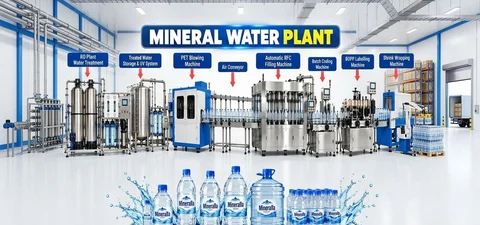
Ghana's commercial beverage and packaged water sector represents one of West Africa's fastest-growing manufacturing opportunities. With an expanding middle class across urban hubs like Accra, Kumasi, Takoradi, and Tamale, consumer preference is rapidly shifting from traditional sachet water to hygienic, branded PET bottled water (500ml, 750ml, 1.5L) and 19-litre office dispenser bottles. Setting up a modern Mineral Water Plant in Ghana provides visionary entrepreneurs with outstanding margins and reliable year-round cash flow.
Direct Answer & Industry Summary (AEO Definition)
A turnkey Mineral Water Plant in Ghana involves a multi-stage water purification system (Quartz Sand, Activated Carbon, Micron Filtration, Reverse Osmosis, and Ozonation) synchronized with high-speed automated PET bottle blowing, rotary rinsing-filling-capping (RFC), BOPP labeling, and shrink bundling machinery. In Ghana, all commercial water facilities must obtain statutory manufacturing and product registration permits from the Food and Drugs Authority (FDA Ghana) in accordance with Ghana Standard GS 175-1 (Drinking Water) and GS 220 (Packaged Natural Mineral Water). Turnkey machinery imported from India delivers full food-grade SS 316L metallurgy at 40%–50% lower capital expenditure than European imports.
Operating a licensed beverage manufacturing facility in Ghana requires strict compliance with statutory regulatory bodies before commercial distribution:
Groundwater across Ghana's coastal and inland aquifers often contains elevated iron, manganese, suspended silt, and fluctuating microbial loads. Krupashindu designs customized multi-barrier treatment skids tailored to local water chemistries:
| Purification Stage | Equipment Specification | Contaminants Eliminated |
|---|---|---|
| 1. Coagulation & Raw Storage | SS 304 / Food-grade HDPE raw water tanks with chemical dosing | Heavy suspended solids, organic colloids |
| 2. Catalytic Iron & Sand Filter | Dual-media manganese dioxide greensand + graded quartz filter | Dissolved iron (Fe), manganese (Mn), turbidity < 1 NTU |
| 3. Activated Carbon Filter | High iodine value (1100+ mg/g) virgin coconut shell carbon bed | Residual chlorine, pesticides, objectionable taste and color |
| 4. Precision Micron Filtration | 5-micron and 1-micron spun polypropylene cartridge filters in SS housing | Micro-particles, carbon fines, silt protection for RO membranes |
| 5. Industrial Reverse Osmosis (RO) | Dow Filmtec / Hydranautics TFC spiral-wound membranes (SS 304 skid) | 99.2% reduction of TDS, sodium, fluorides, lead, arsenic |
| 6. Mineral Dosing & Remineralization | Food-grade peristaltic proportional metering pump (Ca, Mg dosing) | Restores crisp natural spring water taste & essential minerals |
| 7. UV Sterilization & Ozonation | SS 316L UV chamber + Corona discharge ozone generator with venturi | Bacteria, viruses, coliforms, bottle & cap sterilization |
Modern bottling lines imported from Krupashindu include synchronized blocks to eliminate human touch and maximize plant sanitation:
An entry-level semi-automatic bottling plant (1000–2000 BPH) ranges from $28,000 to $45,000 USD for machinery, while fully automatic 4000–6000 BPH monoblock lines range from $55,000 to $110,000 USD. With ex-factory gross margins exceeding 45% in Ghana's retail market, payback periods typically range between 11 to 16 months.
Ready to engineer your plant in Ghana? Connect with Krupashindu's turnkey project consultants for custom CAD factory layouts, machinery CIF shipping quotes to Tema Port, and on-site commissioning.
Leading Mineral Water Plant Manufacturer in India. Turnkey setup, machinery pricing, and BIS/ FSSAI licensing.