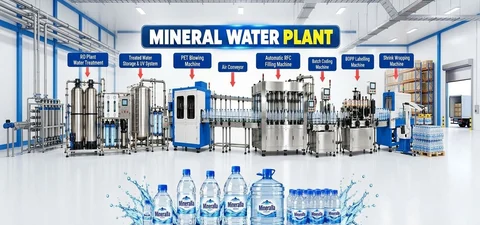
The packaged beverage and bottled water sector in India is experiencing unprecedented expansion, driven by rising consumer health awareness, rapid urbanisation, and booming commercial hospitality demand. If you are planning to enter this high-margin market in 2026, selecting the right Mineral Water Plant Manufacturer In India is the single most decisive strategic choice you will make. A reliable Original Equipment Manufacturer (OEM) ensures seamless engineering, robust food-grade metallurgy, uninterrupted production runs, and rapid Bureau of Indian Standards (BIS IS:14543) licensing approval.
1. OEM Manufacturer vs. Trading Broker: 5 Critical Verification Checks
India's machinery market has many traders who pose as manufacturers. These middlemen purchase disparate components from multiple sub-vendors, paint them identically, and sell them as a "complete plant". This leads to severe integration friction, frequent downtime, lack of warranty accountability, and failed BIS quality audits. When shortlisting a Mineral Water Plant Manufacturer In India, conduct these essential due-diligence checks:
- Physical Factory Audit: Inspect the manufacturer's actual manufacturing and fabrication floor. Verify in-house CNC machining, laser cutting, sheet-metal bending, and argon TIG welding facilities. Krupashindu operates an ISO 9001:2015 certified central manufacturing facility in MIDC Rabale, Navi Mumbai.
- Food-Grade SS 316L Metallurgy: Insist on SS 316L for all product-contact piping, storage tanks, and filling nozzles, with outer frame cladding in SS 304. Traders frequently substitute inferior SS 202, which corrodes under ozonated water conditions and fails BIS chemical inspections.
- Turnkey Engineering Track Record: Choose a manufacturer with at least 15–20 years of verifiable project commissioning across multiple Indian states and international markets.
- Integrated PLC Automation: Ensure synchronized PLC controls (Siemens, Delta, or Schneider) harmonize the RO skid, ozone injection, bottle blowing, and rotary rinsing-filling-capping (RFC) machinery.
- In-House BIS Laboratory Assistance: The manufacturer should supply a complete turnkey chemical and microbiological laboratory and train your chemists to navigate statutory BIS inspections.
2. Standard Commercial Plant Capacities & Machinery Investment
Capital investment depends on your target market (retail 250ml–1L bottles vs 20L commercial dispenser jars), automation level, and daily bottle output:
| Capacity Category |
Output (BPH / JPH) |
Machinery Investment |
Covered Shed Space |
Target Market Segment |
| Semi-Automatic Starter |
1,000–2,000 BPH |
₹16L – ₹24L |
1,200–1,800 sq.ft |
Local retail, rural markets, hotels |
| Commercial Automatic Monoblock |
3,000–6,000 BPH |
₹36L – ₹58L |
2,500–4,000 sq.ft |
District-wide distribution, supermarket brands |
| High-Speed Industrial Rotary |
8,000–16,000+ BPH |
₹75L – ₹1.4 Crore |
5,000–8,000 sq.ft |
Multi-state FMCG bottling, contract manufacturing |
| 20-Litre Jar Bottling Line |
150–450 JPH |
₹14L – ₹26L |
1,500–2,200 sq.ft |
Corporate offices, IT corridors, residential hubs |
3. Core Technological Components in a World-Class Water Plant
As India's foremost engineering technocrats, Krupashindu designs complete turnkey lines featuring top-tier components:
- Multi-Barrier Pre-Treatment: Dual-media pressure sand filtration for turbidity removal down to 30 microns, high-iodine activated carbon absorption for dechlorination, and automatic dual-column ion exchange water softeners.
- High-Recovery Industrial Reverse Osmosis (RO): High-pressure multistage vertical pumps (Grundfos or CNP), thin-film composite (TFC) aromatic polyamide RO membranes (Hydranautics / Dupont Dow Filmtec), and automated chemical cleaning (CIP) systems. Explore our heavy-duty Industrial RO Plants.
- Dual-Stage Disinfection (UV & Ozone): Continuous online high-intensity Ultraviolet sterilization reactors coupled with corona-discharge industrial ozone generators delivering 0.2 to 0.4 ppm dissolved ozone to guarantee sterile shelf life in sealed bottles.
- Automatic PET Stretch Blow Moulding: High-precision infrared preform ovens with rapid pneumatic stretching ensuring uniform bottle wall thickness and crystal-clear clarity. View our Automatic PET Bottle Blowing Machines.
- Rotary Monoblock Rinsing-Filling-Capping (RFC): Class 10,000 sterile enclosure with positive HEPA air pressure, gravity/counter-pressure filling valves, and magnetic capping heads. See our Automatic Rinsing, Filling & Capping Machines.
- End-of-Line Packaging Automation: High-speed optical bottle inspection tables, automatic BOPP hot-melt or shrink-sleeve labeling, continuous inkjet (CIJ) batch coders, and heavy-duty automatic shrink-wrapping tunnels. Explore our Automatic Shrink Wrapping Machines.
4. Bureau of Indian Standards (BIS IS:14543) Licensing Checklist
Operating a commercial packaged drinking water plant in India requires mandatory ISI marking under the IS:14543 specification. You must establish an on-site, fully operational testing laboratory before the BIS inspection officer conducts the initial factory audit. Your laboratory must include:
- Chemical Testing Section: Digital pH meter, analytical balance (0.1 mg accuracy), turbidity meter (NTU), TDS meter, spectrophotometer, burettes, pipettes, and standard chemical titration reagents for total hardness, alkalinity, chloride, sulphate, and nitrates.
- Microbiological Testing Section: Autoclave, laminar air flow cabinet (Class II), bacteriological incubators (37°C and 44°C), membrane filtration assembly, colony counter, hot air oven, and prepared sterile culture media for E. coli, Coliform, Yeast & Mould, and Pseudomonas aeruginosa.
- Qualified Personnel: Full-time approved Chemist (B.Sc / M.Sc Chemistry) and Microbiologist (B.Sc / M.Sc Microbiology) certified to conduct daily batch testing.
5. Regional Engineering Centers Across India
Krupashindu provides specialized local engineering teams, local water analysis, and dedicated technical spares support across all major industrial states in India:
- Maharashtra: Central manufacturing & heavy fabrication works in MIDC Rabale, Navi Mumbai. Read our Mineral Water Plant Manufacturer in Maharashtra guide.
- Gujarat: High-TDS brackish water RO skids and bottling automation across Ahmedabad, Surat, Rajkot, and Vadodara. Explore our Mineral Water Plant Supplier In Gujarat hub.
- Rajasthan: High-recovery defluoridation skids and heat-resilient lines for Jaipur, Jodhpur, and Udaipur. View our Mineral Water Plant Cost in Rajasthan blueprint.
- Telangana & South India: Power-saving VFD skids and 20L bubble-top jar lines across Hyderabad, Secunderabad, and TSIIC estates. Check our Mineral Water Plant Setup in Hyderabad page.
- Delhi NCR: Complete DPCC-compliant bottling lines and 24-hr spares dispatch for Gurgaon, Noida, and Faridabad. Read our Mineral Water Plant Manufacturers in Delhi report.
6. Frequently Asked Questions
How much does it cost to set up a mineral water plant in India?
Complete project setup costs in India range from ₹16 Lakhs to ₹28 Lakhs for a semi-automatic 1,000–2,000 BPH plant, ₹38 Lakhs to ₹60 Lakhs for a fully automatic 3,000–6,000 BPH line, and ₹75 Lakhs to ₹1.5 Crore for a high-speed 8,000–16,000 BPH industrial setup including machinery, water treatment, laboratory, and civil cleanroom construction.
Is BIS IS:14543 certification mandatory for a mineral water plant in India?
Yes. In India, manufacturing or selling commercial packaged drinking water without the mandatory Bureau of Indian Standards (BIS ISI) certification under IS:14543 is illegal. You must also secure an FSSAI Central/State Manufacturing license, State Pollution Control Board Consent (CTE & CTO), and Ground Water Authority NOC.
What is the profit margin in a packaged drinking water business in India?
Operating a standard 2,000 BPH bottling plant at 65%–75% capacity produces an average net profit margin of ₹3.00 to ₹4.50 per 1-Litre bottle and ₹15 to ₹25 per 20-Litre dispenser jar, after accounting for preform resin, label, cap, power, labor, and distribution logistics. This yields typical monthly net returns of ₹6 Lakhs to ₹9 Lakhs, achieving capital payback within 14 to 22 months.
How long does it take to commission a turnkey mineral water plant?
From initial site inspection, water profiling, and civil cleanroom layout planning to machinery fabrication, piping erection, laboratory installation, and BIS inspection clearance, a turnkey plant is typically commissioned within 60 to 90 working days.
Contact Krupashindu's Engineering Technocrats Today to receive a comprehensive Detailed Project Report (DPR), machinery quotation, and site layout design.