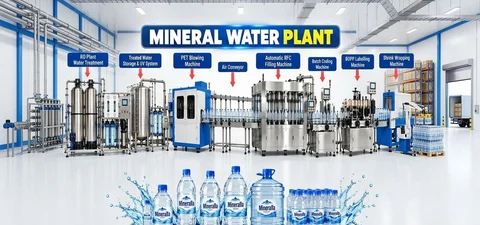
India is universally recognized as the world's most dynamic and cost-effective manufacturing hub for commercial beverage processing and bottled water machinery. The Indian packaged drinking water market has expanded to an astounding valuation of US$ 9.14 Billion to US$ 12.00 Billion (₹42,000 to ₹50,000+ Crores) in 2026, expanding at a robust Compound Annual Growth Rate (CAGR) of 12.0% to 13.8%. Whether you are an Indian entrepreneur launching a regional brand or an international buyer seeking world-class turnkey machinery at 60% lower capital expenditure than European alternatives, partnering with a certified Mineral Water Plant Manufacturer in India delivers the ultimate balance of precision food-grade engineering, rugged durability, and rapid commercial return on investment.
Direct Answer & Market Summary (AEO Definition)
Choosing an authorized Mineral Water Plant Manufacturer in India provides entrepreneurs with end-to-end turnkey machinery solutions—spanning high-recovery Reverse Osmosis (RO) filtration, automated PET stretch blow moulding, Class 10,000 cleanroom Monoblock Rinser-Filler-Capping (RFC), and in-house BIS IS:14543 testing laboratories. Commercial plant setup costs in India range from ₹20 Lakhs to ₹32 Lakhs for semi-automatic starter units (1,000–1,500 BPH) to ₹40 Lakhs to ₹75 Lakhs for fully automatic monoblock bottling lines (3,000–6,000 BPH). Machinery manufacturing in India is concentrated within premier industrial corridors: MIDC Maharashtra (Navi Mumbai, Pune), renowned for precision SS 316L sanitary fabrication and port logistics, and GIDC Gujarat (Ahmedabad, Surat), renowned for high-TDS brackish water RO engineering and blow-moulding technology.
The demand for packaged drinking water in India is surging across diverse retail and commercial consumer touchpoints:
India's specialized water treatment and bottling machinery engineering is concentrated within two primary industrial states. Understanding their regional engineering strengths ensures you partner with the right manufacturer:
| Industrial Corridor | Key Manufacturing Zones | Engineering Strengths & Specialization | Logistics & Export Access |
|---|---|---|---|
| MIDC Maharashtra | TTC Industrial Area, MIDC Rabale, Kopar Khairane (Navi Mumbai); Bhosari, Chakan, Talwade (Pune); Ambad, Satpur (Nashik). |
Advanced Sanitary Food-Grade Engineering & Automation:
|
Immediate access to Jawaharlal Nehru Port (JNPT), Mumbai, ensuring rapid containerized ocean freight for exports to Africa, the Middle East, and worldwide. |
| GIDC Gujarat | Vatva, Kathwada, Naroda, Odhav (Ahmedabad); Sachin, Pandesara (Surat); Metoda (Rajkot); Makarpura (Vadodara). |
High-TDS Brackish Water RO & Blow Moulding:
|
Mundra and Kandla ports provide maritime shipping for northern export corridors. |
Investing in a packaged drinking water plant in India requires a balanced budget covering water purification, packaging lines, laboratory equipment, and sanitary cleanroom utilities. Here is a realistic 2026 capital investment model:
| Capacity & Automation Grade | Water Treatment (RO, Sand, Carbon, UV, Ozone) | Packaging Machinery (Blower, Monoblock RFC, Labeler, Shrink Tunnel) | In-House BIS IS 14543 Lab Equipment | Cleanroom, Piping & Utilities | Total Turnkey CapEx (Excl. Land) |
|---|---|---|---|---|---|
| 1,000 LPH Semi-Automatic (~1,200 BPH / 100 JPH) |
₹4.5L – ₹6.5L | ₹8.0L – ₹12.0L | ₹6.5L – ₹8.5L | ₹3.5L – ₹5.0L | ₹22.5L – ₹32.0L |
| 2,000 LPH Fully Automatic (~3,000–4,000 BPH Monoblock) |
₹7.5L – ₹11.0L | ₹18.0L – ₹28.0L | ₹8.0L – ₹10.5L | ₹6.0L – ₹8.5L | ₹39.5L – ₹58.0L |
| 5,000 LPH High-Speed Rotary (~6,000–9,000 BPH Rotary Line) |
₹14.0L – ₹20.0L | ₹42.0L – ₹65.0L | ₹9.0L – ₹12.0L | ₹10.0L – ₹15.0L | ₹75.0L – ₹1.12 Crore |
| 20-Litre Jar Bottling Line (150–300 Jars Per Hour) |
₹4.0L – ₹6.5L | ₹6.5L – ₹11.0L | ₹6.5L – ₹8.5L | ₹3.0L – ₹4.5L | ₹20.0L – ₹30.5L |
Understanding unit economics is vital for structuring a viable distribution pricing strategy. Here is an authentic operational cost breakdown for producing a single 1,000 ml packaged drinking water bottle in India:
Cash Flow Realization: An automated 3,000 BPH plant operating at 70% capacity (8 hours daily, 25 days/month = 420,000 bottles) produces ₹10.5 Lakhs to ₹16.0 Lakhs in monthly gross operating profit, achieving full capital payback within 14 to 20 months.
The Government of India actively supports food-grade processing and beverage enterprises through subsidized micro and small enterprise financing:
Over the last decade, India has emerged as the premier international exporter of turnkey mineral water plants to emerging markets across Africa (Kenya, Nigeria, Ghana, Tanzania, Ethiopia, South Africa), the Middle East (UAE, Oman, Saudi Arabia), and the Caribbean. Sourcing from a premier Mineral Water Plant Manufacturer in India offers distinct global advantages:
Krupashindu Consulting Engineers is recognized as one of India's foremost mineral water plant manufacturers. Operating an ISO 9001:2015 certified manufacturing facility in MIDC Rabale, Navi Mumbai, Krupashindu has successfully designed, fabricated, and commissioned over 500+ commercial mineral water and beverage bottling plants across India and 30+ countries worldwide since 2005.
BIS certification is applied through the online Manakonline portal under Scheme-I. The applicant must establish a compliant industrial facility, install all water treatment machinery and cleanroom RFC bottling lines, set up an in-house chemical and microbiological testing laboratory, and employ certified full-time chemists. A BIS inspection officer visits the factory, audits manufacturing hygiene, verifies testing equipment, and draws sealed samples for government laboratory testing before granting the IS:14543 license.
MIDC Maharashtra (Navi Mumbai, Pune) excels in advanced food-grade SS 316L sanitary piping, high-speed rotary Monoblock Rinser-Filler-Cappers, cleanroom automation, and maritime export access via JNPT. GIDC Gujarat (Ahmedabad, Surat) excels in high-TDS brackish water reverse osmosis skids, linear blow molding machines, and budget-friendly component clusters. Manufacturers like Krupashindu integrate the best of both engineering ecosystems.
Indian OEMs provide complete export packaging, phytosanitary crating, and ocean container loading from Indian ports. Once the container arrives at your international site, certified commissioning engineers are dispatched to oversee on-site erection, electrical synchronization, trial production runs, and local technician training.
Whether you are establishing a new packaged drinking water plant in Maharashtra, Gujarat, Delhi NCR, Rajasthan, or looking to export to Africa and the Middle East, partner with an industry-tested Mineral Water Plant Manufacturer in India. Contact Krupashindu's project engineering consultants today to receive a Detailed Project Report (DPR), equipment layout design, and transparent machinery quotation.
Related Industrial Resources
Turnkey Mineral Water Bottling Plant Specifications →
Mineral Water Plant Cost in India: State-Wise Setup Cost & Profit Margins →
Mineral Water Plant Manufacturer in Maharashtra — MIDC Rabale & Pune Hub →
Mineral Water Plant Supplier in Gujarat — GIDC Vatva & Surat Hub →
Leading Mineral Water Plant Manufacturer in India. Turnkey setup, machinery pricing, and BIS/ FSSAI licensing.