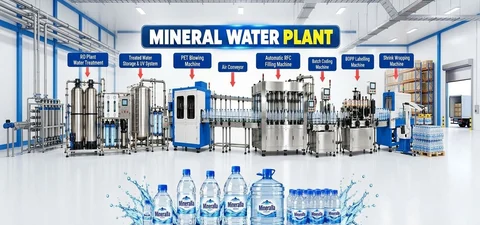
Delhi National Capital Region (NCR)—spanning New Delhi, Gurgaon, Noida, Greater Noida, Ghaziabad, and Faridabad—is India's largest and most densely populated consumer beverage market. With over 32 million residents, tens of thousands of corporate headquarters, luxury hotels, educational institutions, and banquet halls, the consumption of packaged drinking water in Delhi NCR reaches tens of millions of liters daily. For entrepreneurs seeking to tap into this immense demand in 2026, selecting the right partner among Mineral Water Plant Manufacturers in Delhi NCR is vital to ensure long-term operational profitability and stringent statutory compliance.
1. OEM Manufacturers vs. Delhi Machinery Dealers
Delhi NCR has numerous machinery dealers and trading agents concentrated in industrial hubs like Bawana, Mayapuri, and Okhla. However, most of these entities are third-party brokers who do not own manufacturing infrastructure. When technical issues arise, or when specialized spare parts are needed, these dealers lack the technical capacity to service your plant. Partnering with a genuine OEM manufacturer like Krupashindu Consulting Engineers offers decisive advantages:
- Direct OEM Metallurgy Standards: Genuine food-grade SS 316L for all contact piping and storage tanks, preventing leaching and corrosion.
- Unified Line Automation: Synchronized PLC automation ensuring the RO skid, UV/Ozone sterilization, blow moulding, and rotary monoblock filling machine communicate seamlessly.
- Dedicated North India Technical Team: Trained field service engineers based in North India providing rapid commissioning, preventive maintenance, and 24-hr technical assistance across Gurgaon, Noida, and Faridabad.
- Factory Warranty & Spares Dispatch: Direct manufacturer warranties without broker markups, and guaranteed dispatch of critical spares within 24 hours.
2. Groundwater Treatment in the Yamuna Alluvial Floodplain
Groundwater characteristics in Delhi NCR vary depending on distance from the Yamuna river basin and the Aravalli ridge:
- Alluvial Silt & Suspended Turbidity: Yamuna floodplains (East Delhi, Noida, Greater Noida) feature fine alluvial silt and seasonal turbidity. We engineer high-velocity multi-grade sand filtration skids with automatic backwashing to reduce turbidity below 1 NTU.
- Moderate-to-High Hardness & TDS: In Faridabad and Gurgaon, deep borewells encounter hard rock with TDS between 800 ppm and 1,800 ppm. We deploy high-efficiency industrial RO membranes with anti-scalant dosing and dual-column hardness softeners to protect membranes and achieve crisp, refreshing taste conforming to BIS IS:14543. Explore our Industrial RO Filtration Skids.
- Disinfection & Shelf Life: High ambient temperatures in North India during summer accelerate bacterial proliferation. Our dual-barrier disinfection skids—combining high-dosage UV sterilizers with heavy-duty corona-discharge ozone generators—guarantee complete sterility and 12-month sealed bottle shelf life.
3. The Ideal Plant Configuration for Delhi NCR: Dual Bottle + 20L Jar Production
Because of Delhi NCR's massive corporate office concentration in Cyber City Gurgaon, Noida Sector 62, and Connaught Place, setting up a combined production facility is the most profitable business model:
- Automatic 2,000–6,000 BPH Monoblock Line: Packages retail bottles in 250ml (airports, banquets, meetings), 500ml, 1-Litre, and 2-Litre formats. Learn more about our Automatic Monoblock Filling Machines.
- Automatic 200–300 JPH 20-Litre Jar Line: Automatically washes, rinses with ozonated water, fills, and seals 20-Litre bubble top dispenser cans for direct delivery to corporate offices, gyms, and residential complexes.
4. Navigating Pollution Clearances in NCR (DPCC, HSPCB, UPPCB)
Because Delhi NCR is environmentally sensitive, compliance with regional pollution control authorities is rigorous:
- Delhi: DPCC (Delhi Pollution Control Committee) Consent to Establish & Operate. Most plants operate in approved industrial estates such as Bawana, Narela, or Okhla.
- Haryana (Gurgaon & Faridabad): HSPCB (Haryana State Pollution Control Board) CTE/CTO and CGWA groundwater abstraction clearance.
- Uttar Pradesh (Noida & Greater Noida): UPPCB (Uttar Pradesh Pollution Control Board) permissions and industrial zoning clearances.
- BIS IS:14543 Laboratory: In-house chemical and microbiological laboratory fully equipped before statutory BIS audits.
5. Delhi NCR Setup Costs & Return on Investment (ROI)
| Capacity Model |
Machinery Investment |
Turnkey Setup Cost (with Lab & Civil) |
Payback Period |
| 20L Jar Line (200 JPH) |
₹12 Lakhs – ₹18 Lakhs |
₹20 Lakhs – ₹28 Lakhs |
10 – 14 Months |
| 2,000 BPH Retail Bottle Line |
₹18 Lakhs – ₹28 Lakhs |
₹32 Lakhs – ₹44 Lakhs |
14 – 18 Months |
| Combined Jar + Bottle Line |
₹36 Lakhs – ₹52 Lakhs |
₹52 Lakhs – ₹72 Lakhs |
12 – 16 Months |
6. Frequently Asked Questions
How to choose the best Mineral Water Plant Manufacturers in Delhi NCR?
Evaluate genuine OEM fabrication capabilities, verify food-grade SS 316L metallurgy, ensure synchronized PLC automation, check verified customer references across North India, and confirm direct technical service support within 24 hours.
What is the minimum land space required for a water plant in Delhi NCR?
A dedicated 20L jar plant requires approximately 1,200 to 1,500 sq.ft of industrial shed. A 2,000 BPH bottle line requires 1,500 to 2,200 sq.ft, while a combined dual-line facility requires 2,500 to 3,500 sq.ft of covered space with vehicle loading access.
Does Krupashindu assist with DPCC and BIS IS:14543 approvals in Delhi?
Yes. Krupashindu provides end-to-end consultancy for DPCC/HSPCB/UPPCB pollution clearances, Central Ground Water Authority permissions, and complete in-house laboratory setup and chemist training for BIS ISI mark certification.
Explore our regional hub: Mineral Water Plant Manufacturers in Delhi — Regional Hub & Pricing or request a customized project feasibility report.