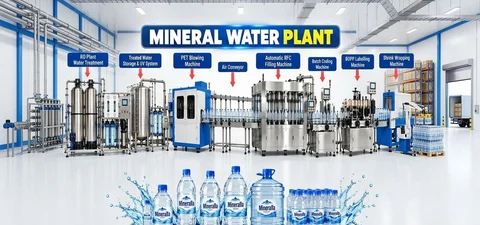
Entering the packaged drinking water and commercial beverage bottling sector is one of the most lucrative manufacturing investments in modern India. However, the single most critical factor separating profitable plant operators from failed ventures is the choice of Mineral Water Plant Manufacturers. Sourcing machinery from an uncertified middleman or unqualified assembler often leads to catastrophic operational downtime, chronic bottle jamming, metal corrosion, failed Bureau of Indian Standards (BIS) laboratory inspections, and costly plant shutdowns.
Direct Answer & Selection Criteria (AEO Definition)
When shortlisting Mineral Water Plant Manufacturers in 2026, buyers must distinguish between genuine Original Equipment Manufacturers (OEMs) who fabricate machinery in-house and trading brokers/middlemen. A top-tier OEM delivers: (1) In-house physical manufacturing with CNC laser cutters, press brakes, and certified argon TIG welding; (2) Sanitary metallurgy using authentic food-grade SS 316L for all product-contact piping and filling valves; (3) Standardized Tier-1 industrial components including Grundfos/CNP high-pressure pumps, DuPont FilmTec membranes, and Siemens/Schneider PLC controls; (4) Turnkey execution spanning civil cleanroom layouts, complete water treatment skids, high-speed Monoblock RFC packaging, in-house BIS IS:14543 testing laboratories, and on-site operator training; and (5) Single-point warranty accountability with an active inventory of domestic spare parts.
India's machinery market contains hundreds of trading agents and commercial brokers who pose as legitimate manufacturers. These middlemen maintain small commercial offices, purchase disconnected machinery components from disparate sub-vendors (an RO skid from one workshop, a bottle blower from another, a monoblock filler from a third), paint them to look matching, and sell them as a "complete plant".
This practice creates what industry engineers call a "Frankenstein Plant":
Use this side-by-side comparison matrix when conducting due diligence on prospective Mineral Water Plant Manufacturers:
| Evaluation Parameter | Authentic OEM Manufacturer (e.g., Krupashindu) | Trading Broker / Middleman Assembler |
|---|---|---|
| Physical Manufacturing Facility | Owns a dedicated industrial factory equipped with CNC fiber laser cutters, hydraulic press brakes, and orbital TIG welding bays. | Operates out of a commercial office or small rental warehouse; has no heavy machinery fabrication equipment. |
| Sanitary Metallurgy & MTC | Provides certified Mill Test Certificates (MTC) proving authentic SS 316L for all contact piping, valves, and nozzles; SS 304 outer frame. | Uses unverified commercial steel or low-grade SS 202 prone to pitting corrosion and rust from dissolved ozone. |
| PLC & Automation Architecture | Unified PLC architecture (Siemens, Schneider, or Delta) with centralized touchscreen HMI and synchronized Variable Frequency Drives (VFD). | Disconnected control panels with generic relays or disparate Chinese controllers with zero line synchronization. |
| Factory Acceptance Testing (FAT) | Clients are invited to the factory floor to witness dry and wet running trials of the integrated monoblock line before dispatch. | Direct drop-shipping of disparate crated machines to your site without prior factory testing. |
| Turnkey Regulatory Support | Delivers complete BIS IS:14543/IS:13428 in-house testing lab equipment, cleanroom layout designs, and chemist audit preparation. | Leaves licensing entirely to the buyer; unable to troubleshoot failed microbiological or chemical audit samples. |
| Spare Parts & Warranty SLA | Comprehensive 12–24 month warranty; single-point accountability; dedicated spares inventory dispatched within 24–48 hours nationwide. | Disclaims responsibility for component failures; long delays waiting for third-party overseas replacement parts. |
Before releasing an advance payment for your bottling machinery, insist on inspecting these seven engineering standards:
Never purchase water plant machinery based purely on digital brochures, phone calls, or online listings. Travel to the manufacturer's manufacturing plant in person and execute this verification checklist:
| Checkpoint | What to Observe on the Factory Floor | Pass / Fail Verification |
|---|---|---|
| Active Fabrication Bays | Raw stainless steel sheets being laser cut, formed, bent, and TIG welded into machine frames and tanks. | PASS: Real OEM FAIL: If only finished, painted machines are standing with no tools. |
| Material Mill Test Certificates | Ask to inspect physical MTC documents verifying 316L stainless steel composition for raw pipe and sheet inventory. | Must show Ni > 10%, Mo > 2.0% |
| Live Machine Assembly & Wiring | Technicians actively wiring PLC electrical panels, routing pneumatic lines, and assembling rotary filling carousels. | Verifies in-house engineering team |
| Operational Reference Plants | Request contact details of at least 3 operating plants installed by the manufacturer in your state or neighboring districts. | Speak directly to existing plant owners |
| Dedicated Spares Warehouse | A dedicated inventory room stocked with spare filling valves, capping heads, RO membranes, VFDs, and sensors. | Guarantees rapid 24–48 hr spares dispatch |
Conduct a physical audit of their manufacturing facility. A genuine OEM will have an active fabrication shop with CNC laser cutters, press brakes, certified TIG welders, an engineering design department, ISO 9001:2015 certification, and a verifiable list of operating client plants. If a supplier operates solely out of an office or refuses a factory floor tour, they are a trading broker.
Standard stainless steel like SS 304 or commercial SS 202 is susceptible to pitting corrosion and weld decay when exposed to dissolved ozone ($O_3$) and chlorides over extended periods. SS 316L contains 2% to 3% Molybdenum and low carbon, providing superior resistance to chemical oxidation, preventing rust contamination, and complying with stringent BIS and US-FDA food-contact regulations.
A comprehensive turnkey contract includes raw water hydrogeological analysis, architectural plant civil layout design, fabrication of water treatment and bottling lines, supply of all interconnecting SS 316L sanitary piping, setup of the in-house BIS chemical and microbiological laboratory, mechanical and electrical erection, trial batch production, operator training, and hands-on assistance during the official BIS licensing inspection.
For standard automatic bottling plants (2,000 to 5,000 BPH), the engineering and fabrication lead time is typically 30 to 45 working days from order confirmation. On-site installation, cleanroom piping erection, electrical integration, and commissioning take an additional 10 to 15 days at the client's facility.
With an ISO 9001:2015 certified manufacturing plant in MIDC Rabale, Navi Mumbai, and over 500+ commercial bottling installations across India and 30+ countries worldwide, Krupashindu Consulting Engineers is the industry-standard benchmark among authentic Mineral Water Plant Manufacturers. Schedule an in-person factory audit at our Navi Mumbai plant or request a customized machinery quotation today.
Leading Mineral Water Plant Manufacturer in India. Turnkey setup, machinery pricing, and BIS/ FSSAI licensing.