Gujarat is one of India's fastest-growing bottled water markets, driven by a hot semi-arid climate, a sprawling industrial workforce, and rising urban health consciousness. Whether you're planning a 1,000 BPH startup in Rajkot or a 10,000 BPH industrial line in Ahmedabad GIDC, selecting the right Mineral Water Plant Supplier in Gujarat determines whether your project succeeds or stalls at the licensing stage.
This comprehensive guide covers everything you need to know about partnering with a trusted Mineral Water Plant Supplier in Gujarat — from GIDC zone selection and brackish water treatment engineering to BIS certification, machinery pricing, and profit projections.
1. Why Gujarat Is a High-Demand Market for Bottled Water
Gujarat's unique geographical and economic characteristics make it one of India's most profitable regions for a packaged drinking water business:
- Climate Factor: Peak summer temperatures of 42°C–46°C across Kutch, Saurashtra, and North Gujarat drive year-round demand. Per-capita bottled water consumption in Gujarat is 28% higher than the national average.
- Industrial Workforce: GIDC estates across Ahmedabad, Vatva, Sanand, Vapi, Ankleshwar, and Morbi house 180,000+ factories. Every industrial unit is a potential institutional buyer for 20-litre jar delivery.
- Tourism & Pilgrimage: Somnath, Dwarka, Statue of Unity (Kevadia), and the Rann of Kutch attract 40+ million visitors annually — all requiring packaged drinking water.
- Government Push: Gujarat's "Make in Gujarat" industrial policy offers subsidized GIDC plots, power tariff concessions, and MSME capital investment subsidies ideal for new water bottling units.
2. Gujarat's Unique Water Challenge: High-TDS Brackish Groundwater
The single biggest engineering challenge in Gujarat is raw water quality. Unlike Maharashtra or Kerala where borewell TDS ranges from 200–600 ppm, Gujarat's groundwater is notoriously saline:
| Region |
Typical TDS (ppm) |
Key Contaminants |
RO Treatment Required |
| Kutch / Saurashtra |
2,500–5,000+ ppm |
Sodium chloride, magnesium sulfate |
Dual-pass RO with brine recovery |
| North Gujarat (Mehsana, Patan) |
1,200–2,800 ppm |
Fluoride (2–6 ppm), hardness |
Single-pass RO + defluoridation |
| Central Gujarat (Ahmedabad, Vadodara) |
800–1,800 ppm |
Iron, hardness, TDS |
Standard single-pass RO |
| South Gujarat (Surat, Vapi, Navsari) |
400–1,200 ppm |
Industrial effluent contaminants |
Pre-treatment + single-pass RO |
A reliable Mineral Water Plant Supplier in Gujarat must engineer RO systems specifically calibrated for these regional water profiles — using high-rejection TFC membranes, antiscalant dosing to prevent silica/calcium carbonate fouling, and energy-recovery devices (ERD) to minimize reject water wastage in high-TDS zones.
3. GIDC Zone Selection: Where to Set Up Your Plant
Gujarat Industrial Development Corporation (GIDC) offers purpose-built industrial estates with pre-approved zoning for food manufacturing. The best GIDC zones for a mineral water plant include:
- Sanand GIDC (Ahmedabad): Premium location near the Ahmedabad-Rajkot Highway, excellent logistics connectivity, ideal for plants supplying metro Ahmedabad and the Gandhinagar government belt.
- Vatva GIDC (Ahmedabad): Established food & beverage manufacturing cluster with existing cold chain and distribution infrastructure.
- Rajkot GIDC (Metoda / Lodhika): Affordable plot rates (₹800–1,200/sq.m) with proximity to the Saurashtra consumer market and growing 20-litre jar demand.
- Halol GIDC (Panchmahal): Central Gujarat hub with access to both Vadodara and the tribal/tourism belt of Central Gujarat.
- Pandesara GIDC (Surat): South Gujarat's largest industrial cluster, supplying Surat's 6 million+ population and the diamond industry workforce.
4. Complete Machinery Line from a Trusted Gujarat Supplier
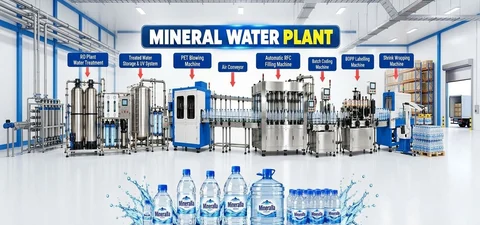
When you partner with Krupashindu as your Mineral Water Plant Supplier in Gujarat, you receive a complete synchronized production line:
- Heavy-Duty RO System (2,000–10,000 LPH): Designed for Gujarat's high-TDS feed water with 75%+ permeate recovery, online TDS monitoring, and automatic membrane flush cycles. View RO Systems →
- Automatic PET Blow Moulding Machine: 2-cavity to 6-cavity automatic units producing 1,500–8,000 bottles/hour from PET preforms. View Blow Moulding Machines →
- Monoblock Rinser-Filler-Capper (RFC): Ultra-hygienic SS 316L construction with positive-pressure filling chamber and integrated cap elevator. View RFC Lines →
- Automatic Labeling & Shrink Packaging: Complete post-fill packaging including sticker labeling, date coding, and heat-tunnel shrink wrapping for retail-ready multi-packs.
5. BIS/ FSSAI Licensing in Gujarat: Step-by-Step
No mineral water plant in India can legally sell packaged drinking water without a BIS ISI mark. Here's the GPCB-specific compliance roadmap:
- GPCB Consent to Establish (CTE): Apply to Gujarat Pollution Control Board for industrial consent with your factory layout, effluent treatment plan, and water source details.
- In-House Laboratory Setup: Equip your QC lab with pH meter, TDS meter, turbidimeter, incubator, autoclave, and laminar flow hood for daily microbiological testing.
- BIS Application (IS:14543): Submit factory layout, process flow, water analysis reports, and QC protocols to the Bureau of Indian Standards.
- BIS Factory Audit: BIS auditors inspect your plant layout, cleanroom compliance, water quality reports, and QC laboratory competence.
- FSSAI Central Manufacturing License: File with the Food Safety Department for interstate distribution authorization.
- GPCB Consent to Operate (CTO): Post-commissioning operational consent with ongoing compliance monitoring.
Krupashindu's in-house compliance team handles the entire BIS and FSSAI licensing process for Gujarat-based plants. Read: Why ISI & FSSAI Certification Are Critical →
6. Investment Breakdown: Mineral Water Plant Cost in Gujarat (2026)
| Component |
1,000 BPH (Semi-Auto) |
4,000 BPH (Fully Auto) |
8,000 BPH (High-Speed) |
| RO Treatment System |
₹3.5–5 Lakhs |
₹8–14 Lakhs |
₹18–28 Lakhs |
| Blow Moulding + RFC Line |
₹8–12 Lakhs |
₹28–40 Lakhs |
₹55–85 Lakhs |
| Labeling + Packaging |
₹2–3 Lakhs |
₹5–8 Lakhs |
₹10–18 Lakhs |
| GIDC Plot + Civil Construction |
₹6–10 Lakhs |
₹15–25 Lakhs |
₹30–50 Lakhs |
| Total Estimated CAPEX |
₹20–30 Lakhs |
₹56–87 Lakhs |
₹1.13–1.81 Crore |
7. Why Choose Krupashindu as Your Mineral Water Plant Supplier in Gujarat
Krupashindu has delivered 80+ turnkey mineral water plants across Gujarat — from Kutch to Surat, Rajkot to Ahmedabad. Our engineering team understands Gujarat's unique brackish water challenges, GIDC compliance requirements, and the high-volume institutional jar market that drives profitability in this state.
Get Your Free Gujarat-Specific Project Quotation →