The demand for hygienic, safe, and premium bottled water is experiencing unprecedented growth. For entrepreneurs, investors, and beverage enterprises entering the market in 2026, selecting the right Mineral Water Plant Manufacturers is the single most critical decision that determines operational profitability, regulatory compliance, and machinery longevity.
1. How to Evaluate Mineral Water Plant Manufacturers
Not all machinery suppliers are equal. When shortlisting Mineral Water Plant Manufacturers, ensure you evaluate:
- Turnkey Engineering Capability: Can the manufacturer design site civil layouts, supply water treatment skids, automate bottling blocks, and provide in-house BIS testing laboratory setups?
- Material Quality & Metallurgy: Insist on SS 316L for product-contact piping and SS 304 for outer cladding to resist corrosion and meet food-grade safety standards.
- Automation & Energy Efficiency: PLC-driven synchronized lines reduce power consumption and eliminate human contact during bottling.
- Global Track Record & Certifications: Look for ISO 9001:2015 certified manufacturers with demonstrated plant installations across domestic and export markets.
2. Core Machinery in a Modern Bottling Plant
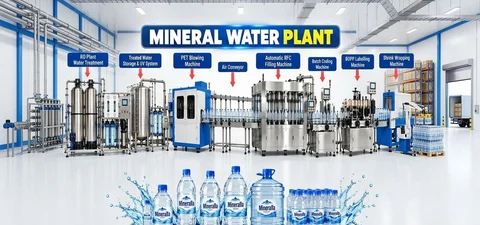
A high-speed, fully automated Bottling Plant integrates synchronized machines into a continuous production flow:
- Raw Water Pre-Treatment Skid: Multi-grade sand filter, activated carbon filter, and water softener unit.
- Industrial Reverse Osmosis (RO) Unit: High-rejection TFC membranes with online conductivity and TDS monitoring.
- UV Sterilizer & Ozonation System: Guarantees microbiological disinfection and extends shelf life in sealed bottles.
- Automatic PET Bottle Blow Moulding Machine: Converts PET preforms into finished bottles at rates from 2,000 to 10,000 BPH.
- Monoblock Rinser-Filler-Capper (RFC): Rinses, fills, and caps bottles in an ultra-clean positive-pressure enclosure.
- Automatic Labeling & Shrink Packaging: High-precision sticker/sleeve labeling and multi-pack shrink wrapping.
3. Setting Up a Compliant Packaged Drinking Water Plant
Establishing a successful Packaged Drinking Water Plant requires adherence to strict government regulations:
- BIS Certification (IS:14543): Mandatory in India. Requires an in-house microbiological and chemical testing laboratory with qualified chemists.
- FSSAI Manufacturing License: Essential food safety approval for packaging and interstate distribution.
- State Pollution Control Board (SPCB) NOC: Environmental consent to establish (CTE) and consent to operate (CTO).
- CGWA Water Extraction Permission: Statutory clearance for groundwater abstraction.
4. Capital Investment & ROI Breakdown (2026 Estimates)
Investing in a Mineral Water Plant yields attractive gross margins (40% to 60%) with payback periods typically between 14 to 24 months. Total initial capital depends on capacity:
- Small Scale Plant (1,000 – 2,000 BPH): ₹15 Lakhs to ₹28 Lakhs for machinery.
- Medium Scale Plant (3,000 – 6,000 BPH): ₹35 Lakhs to ₹65 Lakhs for fully automatic lines.
- Industrial Turnkey Plant (8,000 – 20,000 BPH): ₹80 Lakhs to ₹2.5 Crores for high-speed automated production.
5. Why Krupashindu Leads the Industry
With over 20+ years of engineering excellence and 500+ successful installations across 30+ countries, Krupashindu Consulting Engineers stands as a global benchmark among Mineral Water Plant Manufacturers. From initial site feasibility to final BIS licensing and operator training, we deliver end-to-end turnkey success.
Contact Krupashindu's Engineering Team today to receive a customized project quotation and bankable project report for your beverage facility.