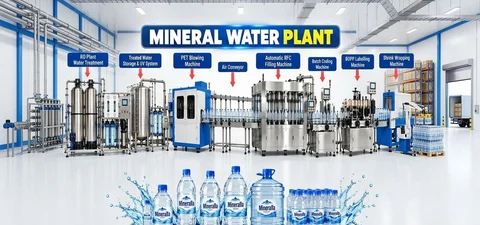
Commercial 1000 LPH Mineral Water Plant setup in India. Complete with industrial RO filtration skid, automatic rotary bottling line, BIS IS:14543 laboratory & PMEGP subsidy feasibility.
Krupashindu designs, manufactures, and supplies complete 1000 LPH Mineral Water Plant (Turnkey Setup Cost & Machinery) setups across India and export markets. Fully automated with PLC synchronisation, food-grade SS 316 metallurgy, and complete warranty support.
The 1000 LPH Mineral Water Plant is the single most sought-after commercial capacity in the Indian packaged drinking water industry. Perfectly calibrated for new manufacturing ventures, regional distributors, and hotel/hospital institutional supply, a 1,000 Litres Per Hour system delivers approximately 2,000 to 3,600 retail bottles (500ml/1-Litre) per hour or up to 60–80 commercial 20-litre water jars per hour.
The total turnkey investment for setting up a 1000 LPH packaged drinking water plant in India ranges from ₹18 Lakhs to ₹26 Lakhs for machinery and laboratory setup. When combined with government subsidies under the PMEGP scheme (15% to 35% margin money subsidy), the net promoter investment drops significantly, ensuring a rapid payback period within 10 to 14 months.
The complete machinery and BIS in-house laboratory setup for a 1000 LPH mineral water plant costs between ₹18 Lakhs and ₹26 Lakhs, depending on the level of bottling automation (semi-automatic vs high-speed rotary monoblock RFC). Government subsidies under PMEGP can reduce this capital cost by 15% to 35%.
A minimum industrial shed area of 1,200 to 1,800 sq.ft is required. This accommodates raw water storage tanks, RO filtration skid, cleanroom bottling enclosure, BIS testing laboratory, packaging zone, and finished goods warehouse.
Producing 15,000 to 20,000 bottles per day at an average production cost of ₹2.30 per bottle and wholesale price of ₹5.00 yields a net profit of ₹2.70 per bottle, resulting in a daily net profit of ₹40,000 to ₹54,000 and an estimated monthly net income of ₹8 to ₹12 Lakhs at optimal capacity.
Yes. A 1000 LPH system can easily be configured as a dual-line facility by integrating an automatic or semi-automatic 20-Litre Jar Washing, Filling & Capping station alongside the retail bottle line.
Leading Mineral Water Plant Manufacturer in India. Turnkey setup, machinery pricing, and BIS/ FSSAI licensing.